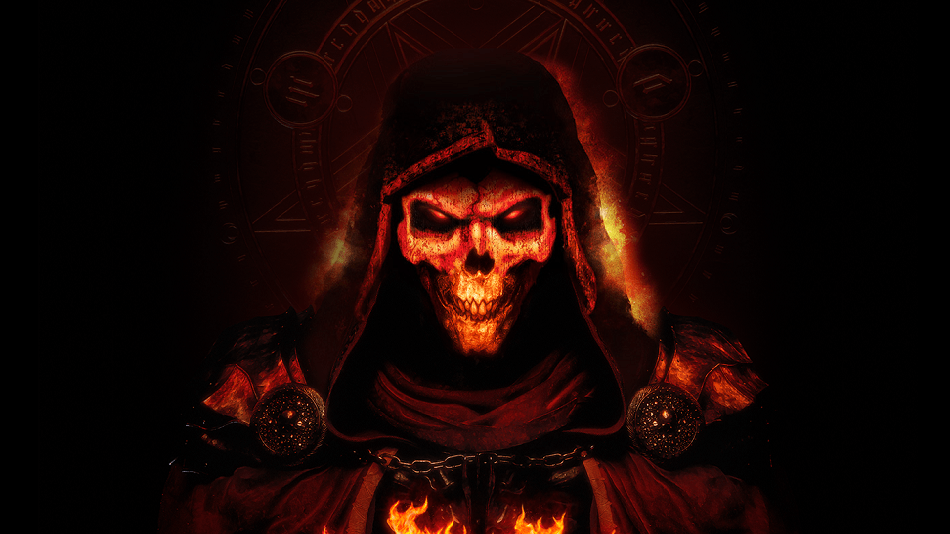
Diablo 1 is the grandfather of the ARPG. Tough bosses, exciting loot, a memorable atmosphere, it brought all the ingredients to the table. Ingredients the genre has been cooking with for almost thirty years now, between games like Grim Dawn, Titan Quest, Path of Exile, and so many more.
Despite this, Diablo’s legacy is overlooked by most people almost completely. All that it did is credited not to it, but to its successor. Like how a chef receives praise over the farmer who raised the crop.
I am, of course, referring to one of the most beloved games of all time: Diablo II.
Any conversation around ARPGs is bound to include Diablo II sooner rather than later. Many consider it to be the greatest game in the genre, if not one of the best of all time, even to this day! You can’t release a game in the genre without it being compared to Diablo II. Not even its own sequels were exempt!
But was it actually that good? Is Diablo II really the best ARPG ever made? Or its legacy upheld purely by nostalgia?
Travel with me to the east. Always east. Today, we’re playing Diablo II.

*Note: for this review, I played the original release of Diablo II with the Lord of Destruction expansion pack. Why didn’t I upgrade to the modernized Resurrected version? A few reasons.
- I bought the original version back in middle-school, before Resurrected existed, so it’s the one I have; besides which, I never beat it as a kid (fuck you Duriel, and your massive difficulty spike too), and I want to conquer that demon once and for all
- I like older versions of games; they’re charming and they take me back to my childhood
- I wanna give modern Blizzard as little of my money as possible; I refuse to reward them for their bad behavior any further than I already have
*To give credit where it’s due, Resurrected is a very good remaster. It adds lots of quality of life improvements, such as expanded storage that can be shared between characters and full controller support. Plus, it’s the only way to go online, and Diablo is at its most fun when you can play and trade with other people. Better yet, you can switch between the modern Resurrected graphics and the original game with the press of a button at any time, ala the Halo 1 & 2 remasters. If you’re gonna play Diablo II in 2023, that version is the best way to go.
Diablo II sets an ominous and mysterious tone with its opening cutscene. A hooded man enters what appears to be a prison, or perhaps an insane asylum. Here, he finds Marius, who will be our narrator for the story going forward. The madman takes the hooded figure for Tyrial, an archangel, with whom he seems to have history. Under the angel’s questions, Marius begins to tell the tale of the Wanderer. Now, the game sets the grim horror tone we remember from the first game, as we see the demons within the Wanderer lash out, consuming an inn in flames and slaughtering all within save for Marius and the Wanderer himself. For reasons even the madman doesn’t understand, he follows the possessed traveler, heading always in the same direction: east.
The premise is simple. Our hero from Diablo 1 is the Wanderer, traveling east to find some way of saving himself from Diablo, leaving a trail of demons and destruction in his wake. Now it’s up to our new character to track him down and defeat the Lord of Terror again. Him, and his two brothers.
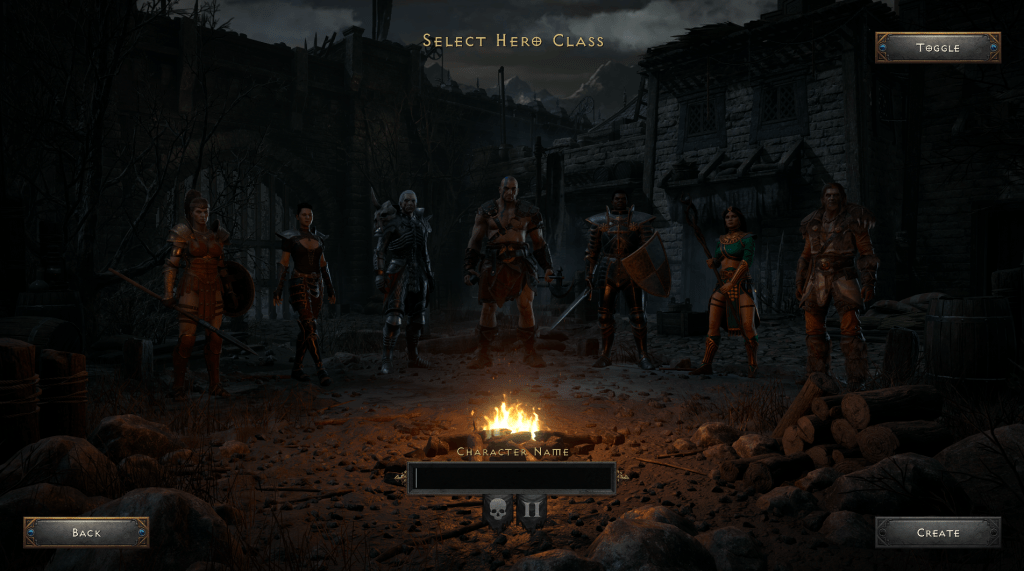
Much like the first game, Diablo II wastes no time getting into gameplay. Pick your class, then bam! You’re in the game. This time, you’ve got seven classes to choose from. They are:
- Amazon: a skilled fighter with a bow and spear
- Assassin: a martial artist that is as fast as she is deadly
- Necromancer: a lord of the dead that summons undead minions and curses his enemies
- Barbarian: the ultimate close-quarters weapon master
- Paladin: a powerful warrior with holy magic and protective blessings
- Sorceress: a mighty elemental caster
- Druid: a furry with the power of the earth and storms
In Diablo 1, the only real difference between the characters was their voice lines and their sprites. Depending on how you built them, you could have done just about anything and used whatever you found. Warriors could cast magic, Sorcerors could wear heavy armor, so on and so forth.
This time around, there are clear and distinct differences between each class and their skills. The undead summoning Necromancer plays completely differently from the shape-shifting Druid. There are even items that are class-specific, unusable by anyone aside from the designated user. Worry not; every single one of them is completely viable. Just choose whichever one looks like fun.
For this playthrough, I decided to go with Necromancer. And I couldn’t think of any better name than that of my last RPG Necromancer hero. Thus Jernabus left Baldur’s Gate behind and made his way into the world of Sanctuary.
A world which also has a Bhaal. Poor dude can’t catch a break…
Stepping into the Rogue Encampment, things immediately feel familiar to Diablo 1. A blacksmith, a magic saleswoman, and a gambler who provides magical items are all here, just as before. Speaking to the NPCs, you gather that they’re refugees from a nearby monastery that was overrun by demons. Now they want you to help them out, starting by going into a nearby cave and slaughtering all the monsters inside.
Right out the gate, we need to talk about the biggest disappointment for me in this game: the characters. The cast of Diablo 1 was my favorite part of the game. Those eight characters were fantastic and fun to chat with; they made Tristram feel so much more real and interesting. But in Diablo II, you do a lot more traveling and meet many more people. As such, the characters you do meet don’t have the same depth of history and personality as the denizens of Tristram. They’re not bad characters, but they’re not nearly as memorable as Griswold or Wirt.
Luckily, we still have Deckard Cain. Or we will. We’ll get to that.
Stepping out of the camp, Jernabus was faced with the second major change between Diablo 1 and II: the map size. Whereas all the areas in the first game were very cramped, the environments in DII are large and open. Thankfully, Blizzard heard all the complaints about movement speed in the first game and added a sprint button. But be careful; you only have so much stamina, and you’ll need to upgrade it with the Vigor stat if you’re looking to run a marathon.
As a necromancer, my gameplay loop is simple: turn enemy corpses into skeletons to fight for me. Further along into the game, I expanded that style, adding ranged projectile magic to support my troops from a distance and curses to weaken my enemies, as well as turning unused corpses into landmines for extra damage. In the event of an emergency, such as a brutal boss fight, I town portal the hell out of there, go to another area, rebuild my troops, then teleport back in to resume the assault.
Cowardly? Cheesy? Perhaps. But I’m already throwing the cadavers of my enemies friends and/or family at them. It’s a bit late for honor and courage.
Jernabus makes his way to the designated cave and kills everything inside, cleansing it of evil. Having earned the trust of the Rogue Encampment, they give him another quest: one of their own has been raised as a servant of evil and they want him to kill her. Speaking to the other campers, he learns that said sister turned demon had actually battled against Diablo before. Much like our own hero from the first game, the Lord of Terror has turned his foe into his slave.
So we go and kill her. There’s some more stuff between there and the camp, but it’s just the standard Diablo gameplay loop. Kill enemies, get loot, feel awesome, rinse, repeat.
Finding good items happens a lot sooner than you’d think. But one thing that makes me sad is the absence of objectively terrible items. Sure, you can find bad loot, but with the game’s crafting system (we’ll get to that) you can eventually turn even the lowliest piece of trash into a worthwhile bit of gear. The loot loop is still satisfying and addictive as ever, but it isn’t as entertaining to me without items like the Sword of Dyslexia.
Slaying the possessed rogue sister, Jernabus returns to the encampment. Having earned the trust of the rogues completely, they offer him one of their own to assist him in his quest. Enter the mercenary system. These AI-controlled party members provide an extra bit of support in combat, giving solo players a little taste of co-op. Mercenaries have their own gear slots, so you’ll need to give them some extra gear to keep up with you and the forces of Hell.
Which I didn’t know was a thing. For my entire first playthrough. So my mercenary was just a meat sponge I had to resurrect every now and again. Whoops.
Not that it really mattered. Mercenary AI is so bad it made Oblivion’s NPCs look like Albert Einstein.
Now with a bit of company, it’s time for yet another quest. This time, Jernabus needs to find and rescue Deckard Cain, who will be an invaluable ally in the pursuit of the Wanderer. To do this, he must find a scroll that will help him activate a portal to Tristram.
So we do that. Does all this questing sound simple? That’s because it is. Like the first game, the story is completely optional. Quests are simple so that people who just wanna go out and kill things can do so unimpeded.
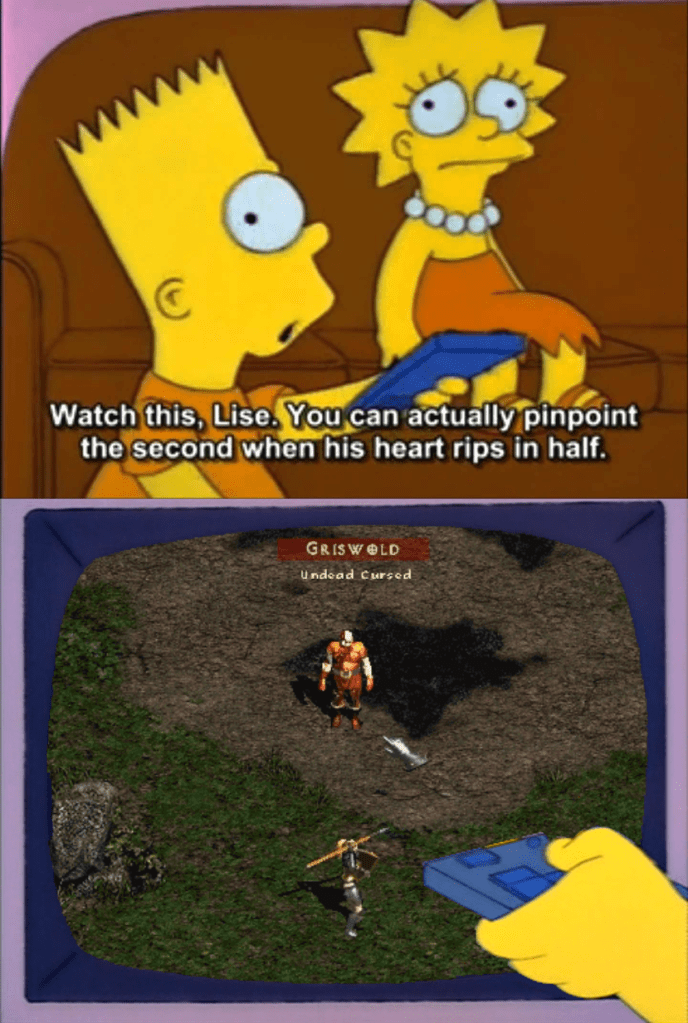
Find the scroll, touch the stones, and open the portal. With all that done, Jernabus makes his way to Tristram. But it’s not as Jernard left it in the first game. The town is a burnt ruin, its denizens slaughtered by a horde of demons. Rescuing Deckard Cain from his cage and opening a portal back to camp, Jernabus remains behind to cleanse the ruins of evil. While doing so, he slays a zombified Griswold and collects Wirt’s peg-leg.
Man, Blizzard really went for the gut there…
With an old friend rescued and another put to rest, our quest continues. Heading up to the monastery and do some more tasks, and we fight our way through the forces of hell to the deepest basement. In the darkness, we confront the boss of Act I: Andariel, Maiden of Anguish.
Which brings me to my second complaint: the bosses. If I’m being completely honest: they kinda suck. Most of them are just battles of attrition. Slowly whittle away at their health, retreat through a town portal if necessary, rinse and repeat until they die and you get loot. That, or hope your character’s number is bigger than the boss’s.
This is one aspect that the later games in the series undeniably improve on. I’ll complain until the sun goes down about Diablo IV and it’s monetization. But even I can admit that the bosses are much, much better than the original games.
Even if other ARPGs like Path of Exile still put said bosses to shame, but that’s a discussion for another time.
Jernabus slays Andariel, and Act I comes to an end. Saying farewell to his friends in the Rogue Encampment, he takes a caravan headed East in pursuit of the Wanderer. But will he be able to catch up in time? Or will Diablo and his brothers rise again and lay the world to ruin?
Play the game and find out. If this plot summary keeps going, we’re gonna be here all day. Besides, you get the picture by now. Do quests, kill bosses, get loot. Rinse and repeat for six acts and you beat the game. Welcome to Diablo II. Enjoy!
Now, we need to talk about this game’s version of crafting: the Horadric Cube.
In Act II, you’ll get the cube for a quest. There are several points in the game where you’ll use this to combine plot-related items into a key item. Beyond that, you can actually use this to repair or even upgrade your equipment. That is, assuming you’ve got all the right gems and runes to do it.
Using the Cube is the best way to create the most powerful items in the game. Unfortunately, I wouldn’t call its use particularly fun. Not only do you have to do a fuck ton of grinding to get all the right gems and runes, but you also need to figure out the recipes yourself. The game gives you basically no information on how to use it beyond its most basic combinations. I had to look up a guide online to use it, and after reading for all of five seconds, I realized there was no way in hell I could have figured it out on my own.
But in that guide, I discovered the way to get into my favorite level of the game. We’ll get to that in a bit.
Once you beat Diablo II, congratulations! You have had an incredibly fun, challenging, and fulfilling ARPG experience! You could wrap it up there, appreciate the game for what it is, and move on to your next play. Or, if you want more, you can hop into the next difficulty level and do it all again.
Much like the first game, Diablo II is almost infinitely replayable. The increasing difficulty provides you with more challenging enemies and better loot with every run. The procedurally generated maps make every playthrough different, even if the areas all still appear in a set order. More than that, the maps will actually get bigger with each subsequent difficulty, expanding the scale of your adventure and give you more to find!
Looking for a challenge? Try a Hardcore run! The difficulty remains the same, but if you die even once, that character is gone forever! If you really want to put your skills and game knowledge to the test, give this challenge a shot!
Not just yet, though. First, we need to go back into the difficulty level we just conquered. Returning to the Rogue Encampment on Normal mode, Jernabus opens the Horadric Cube once again. Inserting his Tome of Town Portal and Wirt’s Leg, we open a red portal within the camp. How odd…
This is the entrance to one of my favorite video game Easter eggs of all time: the Secret Cow Level.

It’s exactly what it says on the tin. A massive open level populated by bipedal cows armed with halberds that calmly say “Moo,” at you over and over as they attack. Does it have some secret super boss? Some ultra-rare loot that puts the rest of the items to shame? Some tease for what we can expect in Diablo III? Who cares?! It’s silly, it’s hilarious, and it’s fun! It doesn’t need to be anything else!
This is why I love Diablo II! It’s grim and dark, yet also silly and fun! It knows when to take itself seriously and when to let the players have a laugh! You can feel the passion of the developers in every single second of gameplay! This was a game crafted by people who loved it and wanted their players to love it too!
Don’t get me wrong, Diablo II has its issues. The boss fights are lame, some aspects are a downgrade from Diablo 1, and the NPC AI is definitely dated. But purely on a gameplay front, this game is every bit as fun to play now as it was back in 2000!
Unfortunately, beyond the second game, the Diablo franchise took a turn and become something I really don’t enjoy. Diablo III was a bright and cartoony loot fest that threw so much crap at you that items became meaningless. Diablo Immortal is a heartless mobile game out to squeeze you for every dime you’ve got. Diablo IV is as wide as an ocean and deep as a puddle, with some of the most egregious monetization I’ve ever seen in a fully-priced triple-A game. It’s clear at this point that Blizzard is making these games for an entirely different audience. An audience players like me are not included in. Chances of us getting another game like the originals is all but gone at this point.
But let’s not let that detract from the legacy of the first two games. Diablo and Diablo II are still every bit as incredible now as they were when they first came out. They’re two of the greatest, most important and revolutionary games ever made, a testament to just how brilliant the Blizzard of old was.
If you haven’t played them, I’d highly encourage you give them a shot. Grab some friends, stay a while and listen, and enjoy yourself. Whether you grind to become a Hardcore player or you just want to experience the story, these games are truly unforgettable.
Glory and approbation to Diablo, Lord of Terror and Leader of the Three!
 Jonah's Books & Rants
Leave a comment