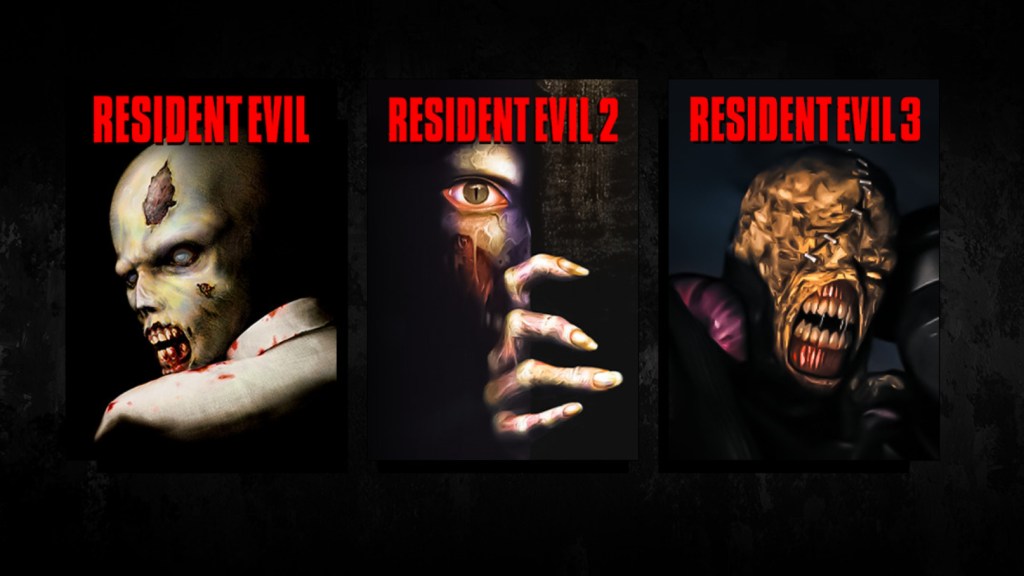
You have once again entered the world of survival horror. Good luck!
On March 22nd, 1996, Capcom released the first entry in a brand new horror IP: ‘Biohazard’. Just over a week later, on April 1st, the game came to North America under the title of ‘Resident Evil’. Created by legendary director Shinji Mikami, this landmark release would coin a whole new genre: survival horror.
In the thirty years since then, ‘Resident Evil’ has become one of the most successful and beloved video game franchises in the world. There are sequels, spin-offs, remakes, live action and animated films, TV shows, comic books, novels, you name it. Ask any horror game fan what their favorite series is, and there’s a high chance they’ll answer RE.
Since the release of ‘Resident Evil 7: Biohazard’ back on January 24th, 2017, the series has reached brand new heights of success. Capcom’s RE Engine has become the foundation for some of their most ground breaking titles to date. Including remakes of the first four games in the series, making those older titles more accessible to newer audiences.
Including myself. While I have known about the series most of my life, I never actually played one until ‘Resident Evil 2 Remake’ came out back on January 25th, 2019. That game quickly became one of my all-time favorites. Since then, I’ve kept a close eye on the franchise, eagerly awaiting every new release.
Yet for all that, I never played the original trilogy. I’ve spent all my time climbing amidst the tree’s branches, never once looking to the roots. Luckily, those classic titles became available on GOG in 2025, then again on Steam on April 1st of this year (I see what you did there, Capcom). So, in honor of the franchise’s 30th anniversary, I finally gave them a shot.
Open the glove compartment and take the gun therein, my dear reader. Let’s enter the world of survival horror together.

The year is 1998. In the Arklay forest, there has been a string of mysterious cannibalistic murders. S.T.A.R.S., Raccoon City’s elite police force, sends their Bravo Team to investigate. When they go missing, the Alpha Team, led by Captain Albert Wesker, goes to investigate. They are ambushed by a pack of ravenous dogs, and forced to flee into a nearby mansion. In the chaos, the team is split up, left to wander this mysterious residence of evil.
You play as S.T.A.R.S. members Jill Valentine or Chris Redfield. Each one has their own unique story set within the mansion. Both investigations end with the same terrible discovery: Umbrella, an enormous pharmaceutical company, has been running experiments within the mansion, creating horrific bio-weapons to sell on the black market. Worse yet: there is a traitor within S.T.A.R.S.
Sixth months later, the events of ‘Resident Evil 2’ begin. After the surviving S.T.A.R.S. members escape the Spencer Mansion, Umbrella’s T-Virus spreads into the populace of Raccoon City. Unaware of the danger, Claire Redfield rides into town to find her brother, Chris. After escaping a zombie ambush in a local diner, she meets future gaming icon: Leon S. Kennedy, a rookie cop having the worst first day imaginable. Together, they flee to the Raccoon City Police Department.
Like the first game, each character has their own campaign. Claire comes across Sherry Berkin, daughter of Annette and William, the Umbrella scientists responsible for the new and deadly G-Virus. Meanwhile, Leon crosses paths with Ada Wong, an FBI agent out to get a sample of G and take down Umbrella. Or so she says…
‘Resident Evil 3’ takes place at the same time as RE2. Returning protagonist Jill Valentine is forced to flee from her apartment after a sudden explosion. In the time since escaping the Spencer Mansion, she has dedicated herself to destroying the Umbrella Corporation. Now, the bio-weapon manufacturer wants to remove this thorn from their side. To get S.T.A.R.S. out of the way, they unleash their deadliest weapon yet: Nemesis. Together with Carlos, a mercenary hired by Umbrella for a secret mission, Jill must evade this predator and escape the city of death.
All three of these stories are simple, cheesy, and wonderfully charming. They definitely show their age, with hilariously stiff dialogue and awkward voice acting. But that’s all part of what makes them so memorable. Silly as they are, some of these lines are legitimately iconic.
Make no mistake. While these games can be hysterical B-horror movie, they can also be genuinely frightening. Thanks in large part to environmental storytelling. The pre-rendered backgrounds are chalk full of details that bring these horrific settings to life. Splashes of blood warn you of dangerous enemies ahead. Half-eaten corpses lay rotting in shadowed corners. Webs line the walls where a spider has made its lair. Scattered everywhere you go are notes written by those lost in these tragedies, each one the echo of a weeping ghost.
Or more often: a not-so subtle hint for the next puzzle.
One of my favorite moments came early in RE3. Backtracking to find a key item, I came across a woman screaming for help whilst running from a small horde of zombies. Slipping past them, I gave chase, spurred on by her screams of terror. Only to find that same woman dead on the ground, another zombie standing over her corpse. It is a haunting moment, even today.
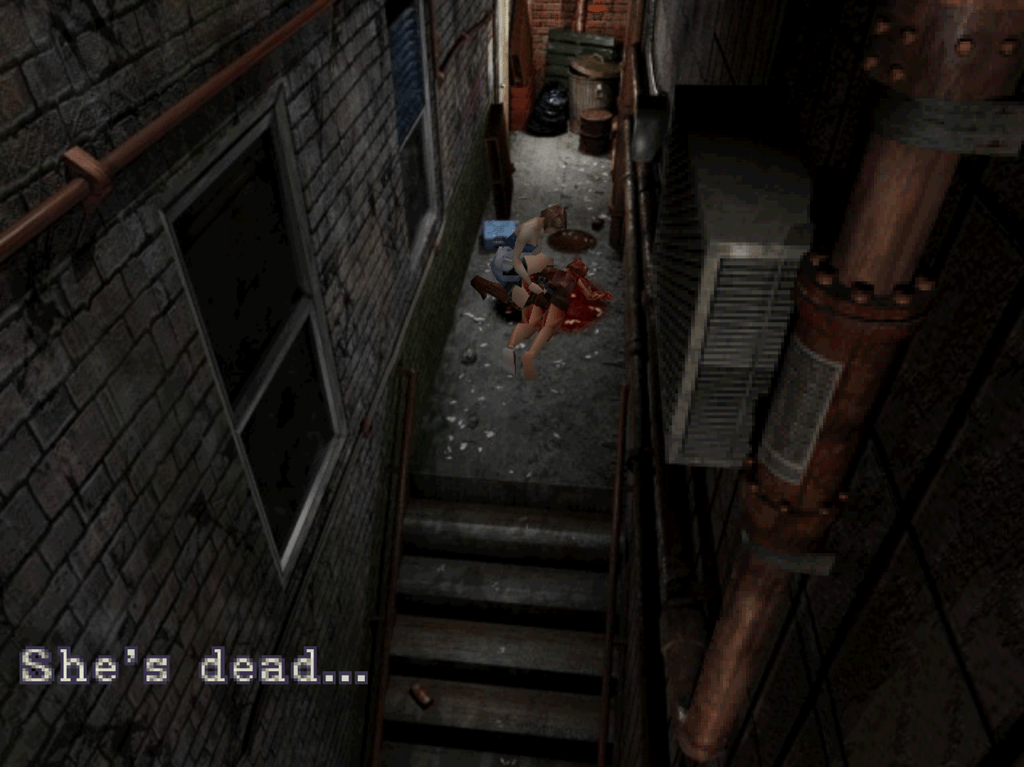
Another key player in building tension is the camera. Every room in the game has a series of fixed camera angles, framing every moment like its a shot in a movie. Often times, enemies will be somewhere out of view, forcing you to stop, listen, and take a more careful approach. I’ve heard a lot of people complain about these, but honestly, I really like them. Not only is it cinematic, but it gives me this uncomfortable sense that I’m being watched.
While you might not be able to see a zombie, you can at least hear it. The sound design in these games is excellent. All the guns sound amazing, their shots punctuated by the clink of empty shells hitting the ground. Groans and shambling footsteps will warn you of approaching danger. Broken glass on the floor will alert enemies to your presence. Your ears will often be a more valuable asset than your weapons, so listen closely.
Besides, you wouldn’t want to miss the music. All three of these games have absolutely incredible scores. My favorite of the lot is RE2’s save room theme. It is a beautiful, soothing melody, yet it also fills you with dread. Here, you are safe. But that peace can’t last. Sooner or later, you’ll have to step outside again.
Alas, the GOG versions did not include the RE1 Director’s Cut. The iconic Basement Theme is nowhere to be heard. Rest in peace to the single greatest musical piece ever composed for a video game.
The visuals certainly show their age. All the pre-rendered backgrounds are impressive, but heavily compressed to fit its original hardware restrictions. The character models are more detailed than a lot of other PS1 games; I especially love how everyone shows proper trigger discipline outside of combat. Even so, they’re still more like blocky action figures than people.
And I love it. This was the era of gaming I grew up with, and I will never get tired of it. Honestly, I wish more games looked like this today. Besides, there are plenty of mods to remove the compression and raise the game to higher resolutions.
My absolute favorite parts are the cutscenes. Both RE2 and RE3 feature 3D animated cutscenes. They’re hardly the quality of an early Pixar film, but they’re still charming and enjoyable. RE3’s in particular still look pretty good. Personally, I prefer the live action FMVs of RE1. The opening of the original game is the perfect blend of unsettling imagery and chuckle-worthy awkward performances.

Although I do think the improvement was worth it in one area. See, each character in each game has a portrait in the inventory screen. In RE1, those portraits are heavily compressed photos of the live action actors. But in the succeeding games, they are much nicer anime-style illustrations. They look much nicer and better fit the series aesthetic.
Now, onto the actual games. In terms of gameplay, all three of these are pretty much the same. There are some quality of life improvements between each sequel, but the core loop remains identical. Each game is basically an escape room; with your limited resources, you need to find key items and solve puzzles to open areas which were previously inaccessible. It’s ‘Metroid’ with cops and zombies.
That would explain why I’m so addicted to it…
Resource management is key across all three titles. There are a lot of monsters barring your path, and not a lot of bullets. More importantly: you only have so many inventory slots. Most characters have eight, but poor Chris only gets six. You’ll often need to backtrack through areas to store your clutter in the trusty box and make room for key items.
This creates a great balance of risk and reward; do you waste precious ammo to kill that zombie, making the room easier to traverse, or do you to dodge around it, leaving it to attack you again later? Do you keep a healing item on hand at all times, or risk not having it to keep space for a key item?
The risks are heightened by the game’s controls. You cannot move and shoot at the same time. Combat is all about positioning, planting your feet at a safe enough distance to bring your target down before it reaches you. This leads to some genuinely terrifying moments. You’ve put seven rounds in that zombie’s chest, and he didn’t care. Now he’s on top of you, and you don’t have time to run anymore. All you can do is keep shooting and pray.
Often times, dodging will be the better option. But that is easier said than done. See, all three of these games use tank controls. For those of you too young to know what that means (God, I’m old…) it’s pretty much exactly what it you’d expect. Your character can only move forward and backward. If you want to turn around, you need to slowly turn in place, giving enemies ample room to close in and attack. At least until RE3 added the quick turn.
At first, I absolutely hated these controls. Modern games have spoiled me rotten. But now that I’m used to it, I’ve come around to liking them. Most enemies are slow enough that the stiff movement almost never feels unfair. When you manage to dodge a horde of zombies without taking a single hit, it feels so damn satisfying. Plus, it makes transitioning between fixed camera angles much smoother.
Every enemy has a real chance to kill you, making every encounter tense and alarming. Zombies are weak on their own, but in packs, they’ll pass you around like a Thanksgiving turkey. Spiders can poison you, and spawn a horde of mini-spiders upon death. Hunters are fast, tough, and hunt in packs, making them just as hard to kill as they are to dodge. Lickers are almost as deadly, but blind, giving you a chance to sneak around them. But mind your step; one heel on broken glass, and it’ll come running.
Then there are the boss fights. There’s no sneaking around these massive bio-weapons (most of the time, at least.) But in my experience, most of these guys are pretty easy. Some of them have gimmicks that kill them immediately, and others are just bullet sponges you can tank through with enough healing items. If you save your more powerful weapons for them, you can be done with it in just a few shots.
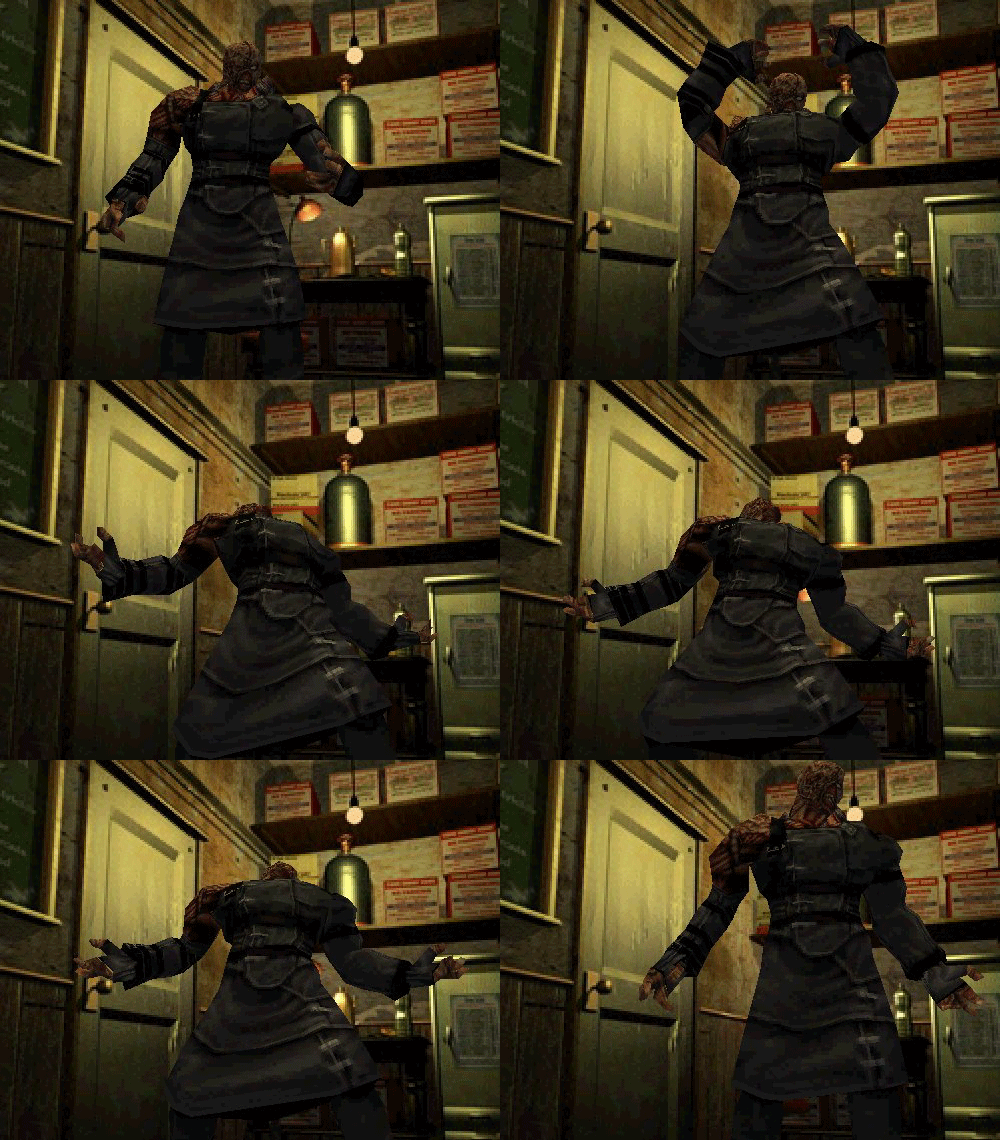
With one exception: RE3’s titular Nemesis. He is, by far, the most terrifying enemy in the whole trilogy. Unlike other bosses, who are restricted to their arenas, Nemesis can attack you seemingly at any time, any place. He’s fast, smart, extremely deadly, and even more durable. Try to run away, and he’ll pull out a god damn rocket launcher! Or he’ll just charge you down at full speed.
If you manage to kill him, he’ll drop some of the most valuable items in the game. But it takes a lot of resources to do so, which will make the next stretch of the game much more difficult. It is the ultimate expression of the risk-reward loop that makes survival horror so much fun. Nemesis alone made RE3 my favorite of the trilogy. This is one of the best video game bosses of all time, full stop.
When you’re not fighting Umbrella’s highly marketable nightmares, you’ll be solving the many puzzles barring your road to freedom. Most of these are extremely simple. Find a key item, plug it into the the lock, move on. But some will make you exercise your little gray cells, like that damn computer in the labs of RE1. Luckily, most aren’t nearly so annoying as that one.
Each title has unique mechanics to set them apart from one another. RE1 is the baseline, establishing the core gameplay loop the others will follow. In RE2, the actions you take with one character will have consequences for the other; an item you don’t grab as Claire will be there for Leon. RE3 adds the quick-turn, ammo crafting, and the world’s most useless dodge mechanic.
All three of these games have a lot of replay value. Both RE1 and RE2 have multiple campaigns, and RE3 has multiple branching paths in its choice system. Once you beat the game, you’ll be given a score based on your time and overall performance. Depending on how well you did, you’ll unlock a series of extra goodies for future playthroughs. These range from alternate costumes to powerful weapons w/ infinite ammo. RE3 also has the Epilogues, extra files detailing what happened to the characters after the trilogy’s end.
Almost all of which have been retconned into oblivion by the sequels.
RE2 and 3 also have extra side modes, in case you wanted a bit of dessert. RE2 has the 4th Survivor mode, a challenging gauntlet featuring Umbrella super-soldier Hunk, as well as sentient Vegan alternative: Tofu. RE3 has the Mercenaries mode, in which you fight enemies for points. Both are wonderful little cherries atop these delicious sundaes.
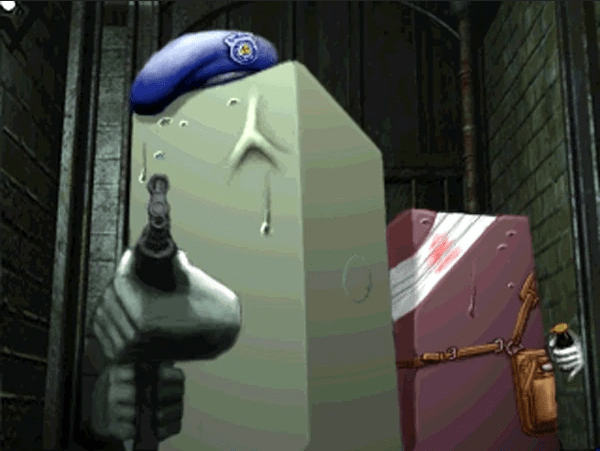
I absolutely loved my time with the ‘Resident Evil’ trilogy. Equal parts charming, hilarious, and unsettling, all three games are still a ton of fun, even today. While they definitely show their age, these titles are all landmarks in the annals of gaming history.
In their time, these games were bastions of innovation and creativity within the industry. They pushed the envelope of what video games could be, in terms of their visuals, their storytelling, and their core gameplay experiences. Which makes it all the more impressive that, to this day, this franchise is still doing exactly that with its new releases, like Requiem.
To all the incredible devs worked on these games: thank you. Your work has brought so much joy and terror to millions of people across the world. Here’s to thirty years of ‘Resident Evil’.
And thank you, dear reader, for reaching the end of this post. What started as another rant quickly became a passion project for me. I sincerely hope you enjoyed it as much as I did.
Until next time: stay safe, and don’t give in to fear.


Leave a comment