Video games have changed a lot since I was a kid. Physical copies are becoming progressively rarer. The games themselves are simpler and easier to get into than ever. Where once games could only fail if the console did, now the games themselves are such monumental financial undertakings that they can flop harder than any box office failure ever did in cinematic history.
But you know what makes me really sad? Physical copies of games don’t come with stuff anymore. Open the case, and all you’ll find is the disk (which probably has nothing on it anyways). The bare minimum. When I was growing up, games came with stuff! Pamphlets, stickers, and the subject of today’s article: little books!
And sometimes not-so-little. We’ll get to those.
Game manuals served a simple purpose. See, back in the early days of video games, developers were extremely limited in what they could put on a cartridge or a disc. NES games usually couldn’t deliver story through cutscenes or even give players tutorials on how to play. So, to sidestep the issue, games came packaged with manuals that told you what was going on and how to play. Much like board game manuals.
Now, I understand why they went away. No one wants to do homework or study in order to play a game. If you want to read a book, go to the library. If you want to play a game, play a game. I get it.
Yet I can’t help but mourn for what we’ve lost. Not every game manual was a textbook (though plenty were, such as old PC RPGs like Fallout and Baldur’s Gate). Plenty of them were simpler, focusing more on charm while being just as helpful.
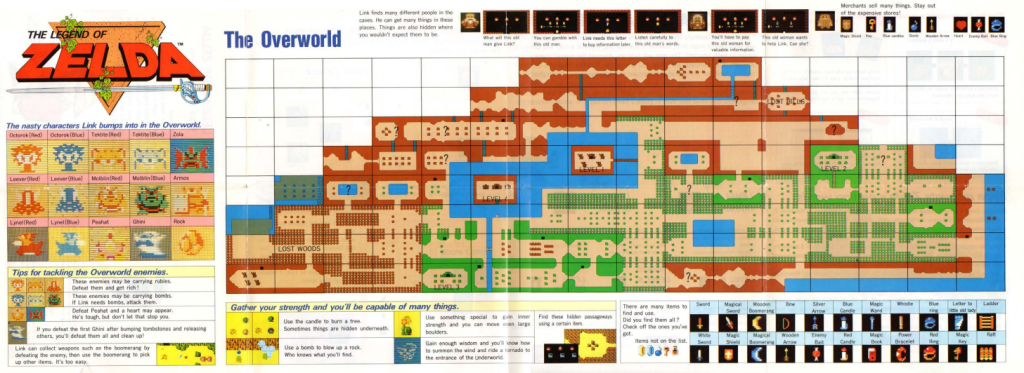
Old Nintendo manuals were fantastic not because they taught you how to play, but because they added to the game! Zelda manuals contained unique artwork that brought the sprites to life, as well as coming with a map to make things easier for kids to track! Mario manuals didn’t just have helpful tips and advice, they developed the identities of every enemy in the game, which is partly why they’re all so iconic to this day!
Of these, the original Metroid manual is my favorite. It established the story and setting in a few short pages, using delightfully charming cartoon renditions of Samus and her various enemies. Oh, did I say her? Because the manual has our favorite bounty hunter put down as a him. You could interpret that as a mistranslation or a simple inaccurate assumption, but I like to think of it as a deliberate misdirection to make the reveal of her true face at the end of the game all the more shocking. It even comes with a little spreadsheet at the end for you to record your passwords in!
Ah, passwords. One aspect of older games I do not miss.
Baldur’s Gate 1 has one of my favorite manuals of all time. The original version, specifically. The EE version is decent enough, but the original had so much charm and personality! The guide was interspliced with comments by characters in the lore, such as Volo or Elminster! It added another layer of love and fun to a game already brimming with both!
Thank god, too. That one was over ninety pages. If I’ve gotta read an instruction manual on a video game, at least make it a fun instruction manual!
Now, technically, instruction manuals still exist to an extent. Some games come with digital PDF manuals. But they’re nowhere near as charming or as helpful as their printed counterparts. Nowadays, games are so accessible that you don’t need any sort of manual to play them; most modern games practically play themselves, and those that don’t will teach you how to play anyways. These examples feel half-hearted and unnecessary.
Unfortunately, as these manuals are printed media, they’ve already begun to fade away with time. The precious few that haven’t begun to deteriorate are now collector’s items, and like any collector’s item, they can get rather ridiculous with their prices. Much as I love these charming little books, I’m not gonna spend more on them than I did on the actual games!
Luckily, you can find them preserved in PDF format over on gamesdatabase.org. Thank god, too. It would be a crime against humanity if these were lost to time. Plus, I’ve had a ton of fun re-reading some I remember from my childhood on there while doing research for this article.
Game manuals are an artform that we’re likely never going to get back. The closest thing we have to it these days is Rockstar games including a map in their physical releases. No one else in the industry is even willing to go that far.
But that’s just the way of time. Even this very blog post will meet the same fate someday. All we can do now is cherish the memories.
That, and shake our fists and complain like grouchy old people.
 Jonah's Books & Rants
Leave a comment